
Introduction: Why the Immune System Matters in Cancer
Cancer does not become dangerous the moment a tumour appears. Long before a tumour can be detected, a silent battle is already taking place within the body. Every day, the immune system continuously monitors billions of cells, searching for anything unusual or potentially harmful. Its primary role is to identify threats and eliminate them before they can cause damage. Viruses, bacteria, and abnormal cells are often detected and destroyed without any noticeable symptoms. Cancer becomes a serious challenge when it develops ways to evade this natural surveillance system and avoid immune detection. Understanding how the immune system recognizes and responds to cancer has become one of the most important advances in modern oncology. At the center of this process are dendritic cells, specialized immune cells often described as the “generals” of the immune system because they help coordinate and direct immune responses against potential threats.
What Are Dendritic Cells?
Dendritic cells are a specialized type of white blood cell that serve as the body’s intelligence and communication network. Unlike other immune cells that directly attack infections or abnormal cells, dendritic cells focus on gathering and processing information about potential threats. They continuously travel throughout the body, identifying unusual substances such as viruses, bacteria, or abnormal cells, and then relay this information to the immune system. Think of them as military commanders rather than soldiers. While other immune cells carry out the attack, dendritic cells provide the critical instructions, helping the immune system recognize where and how to respond. By coordinating immune activity, they play a vital role in protecting the body from disease.
The Immune System’s “Generals”: Understanding Their Role
A simple way to understand the immune system is to imagine a national army.
- T-cells are the soldiers.
- Natural killer cells are the special forces.
- Antibodies are precision-guided weapons.
- Dendritic cells are the generals and intelligence officers.
Without generals, even the most powerful army becomes ineffective.
Similarly, without dendritic cells, the immune system struggles to recognize and respond to cancer effectively.
Their role is not simply to identify danger but to teach the immune system exactly what the danger looks like.
How the Body Normally Identifies Threats
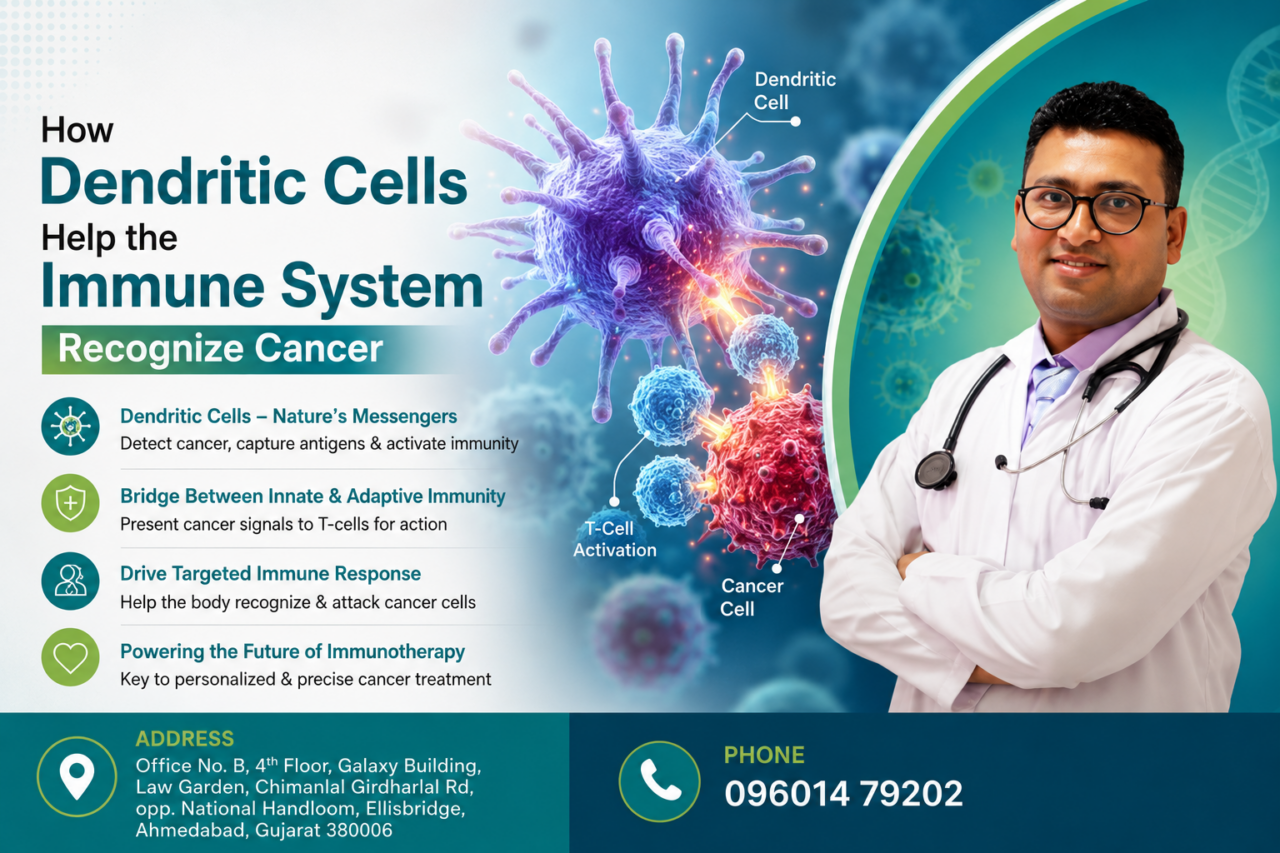
When viruses or bacteria enter the body, dendritic cells capture small fragments of these invaders, known as antigens. They then travel to nearby lymph nodes, where they present this information to T-cells. By doing so, dendritic cells teach T-cells what the threat looks like and help them recognize it wherever it appears in the body. Once activated, T-cells begin searching for and targeting cells carrying the same markers. This highly coordinated process enables the immune system to launch a precise and effective attack rather than a random response, making it one of the most sophisticated defense mechanisms in human biology.
How Cancer Hides from the Immune System
Cancer is different from viruses and bacteria.
Cancer cells originate from the body’s own tissues.
Because of this, they often appear normal to the immune system.
Over time, cancer develops strategies to:
- Avoid immune detection
- Suppress immune responses
- Create protective environments around tumours
- Prevent immune cells from attacking effectively
This is one reason cancer can continue growing despite the presence of an otherwise healthy immune system.
The problem is not always that the immune system is weak.
Sometimes the problem is that it simply cannot see the enemy clearly.
Why T-Cells Cannot Fight What They Cannot Recognize
T-cells are among the most powerful cancer-fighting cells in the body, but they have an important limitation: they require clear instructions to recognize their target. Without accurate information, T-cells cannot reliably distinguish cancer cells from healthy cells. It is similar to asking a police force to locate a criminal without a photograph or description—the task becomes extremely difficult. Dendritic cells solve this problem by identifying cancer-related markers and presenting them to the immune system. By providing this critical information, dendritic cells help T-cells recognize cancer cells and direct their attack toward the correct target.
How Dendritic Cells Help the Immune System Recognize Cancer
This is where dendritic cells become incredibly important.
The process happens in several steps.
Capturing Cancer Antigens
Dendritic cells collect proteins and markers released by cancer cells.
These markers act like fingerprints that identify the cancer.
Processing the Information
The dendritic cells analyze these cancer-specific markers and prepare them for presentation to the immune system.
Activating T-Cells
The dendritic cells then present this information to T-cells.
This teaches the T-cells what cancer cells look like.
Launching an Immune Attack
Once activated, T-cells begin searching throughout the body for cells carrying those same cancer markers.
When they find them, they attack and destroy them.
This process transforms a passive immune system into an active cancer-fighting force.
What Happens When Dendritic Cells Are Not Working Effectively?
In some cancer patients, dendritic cells may become less effective at communicating with the immune system.
Cancer can interfere with normal immune signaling, making it harder for dendritic cells to activate T-cells.
When this happens:
- Cancer may grow more easily.
- Tumours may evade immune surveillance.
- Immune responses become weaker.
- Disease progression becomes more likely.
This challenge has become a major focus of modern cancer research.
Why Scientists Focus on Dendritic Cells in Modern Cancer Research
Researchers have spent decades investigating why the immune system often struggles to recognize and eliminate cancer. Throughout this research, dendritic cells consistently emerged as a critical component of the immune response. Scientists discovered that if dendritic cells could be trained to identify cancer-specific markers more effectively, they could help educate the immune system to recognize and attack cancer cells with greater precision. This insight led to the development of dendritic cell-based immunotherapy, a treatment approach designed to enhance the body’s natural defenses against cancer. Today, dendritic cell therapy is considered one of the most promising areas of personalized cancer treatment, offering new possibilities for targeted and immune-driven care.
Understanding Dendritic Cell-Based Immunotherapy
Dendritic cell-based immunotherapy is a personalized cancer treatment that uses the patient’s own immune cells to improve the body’s ability to recognize cancer. Rather than attacking cancer directly, this approach strengthens the communication between dendritic cells and T-cells, helping the immune system identify cancer cells more accurately and respond more effectively. Because it is based on the patient’s own immune system, it represents an innovative and highly individualized approach to cancer care. This is one reason why doctors such as Dr. Vikesh Shah focus on educating patients about the growing role of immune-based cancer treatments and their potential in modern cancer management.
How Personalized Cancer Vaccines Are Created Using Dendritic Cells
One of the most innovative applications of dendritic cells is the development of personalized cancer vaccines.
The process generally involves:
- Collecting a sample of the patient’s blood.
- Isolating dendritic cells.
- Exposing those cells to cancer-related markers.
- Training them to recognize the cancer.
- Reintroducing them into the body.
Once returned, the trained dendritic cells help guide the immune system toward cancer cells.
Because the therapy is built using the patient’s own cells, it is uniquely tailored to the individual.
Why Dendritic Cell Immunotherapy Is Different from Chemotherapy
Chemotherapy works by targeting rapidly dividing cells, which can affect both cancerous and healthy tissues. Dendritic cell immunotherapy takes a different approach by helping the immune system recognize and respond to cancer more effectively rather than attacking cancer directly. This represents a significant shift in cancer treatment philosophy, focusing on empowering the body’s natural defenses to participate in the fight against cancer. According to Dr. Vikesh Shah, this personalized approach has attracted growing interest among patients seeking advanced treatment options that can complement conventional cancer therapies.
Which Types of Cancer May Benefit from Dendritic Cell Immunotherapy?
Researchers continue to study dendritic cell-based approaches across various cancer types.
These may include:
- Breast cancer
- Lung cancer
- Colon cancer
- Prostate cancer
- Ovarian cancer
- Kidney cancer
- Pancreatic cancer
- Oral cancer
Suitability depends on the individual patient’s diagnosis, stage, medical history, and overall treatment plan.
Every case requires careful medical evaluation.
Can Dendritic Cells Help Reduce the Risk of Cancer Recurrence?
One of the most promising aspects of immunotherapy is immune memory.
When the immune system successfully learns to recognize cancer cells, it may retain that knowledge for future protection.
This concept is similar to how the immune system remembers certain infections after vaccination.
Researchers are actively investigating whether stronger immune recognition may help reduce the likelihood of cancer returning in some patients.
While ongoing studies continue to explore this area, immune memory remains one of the most exciting possibilities in modern oncology.
The Future of Personalized Cancer Treatment
Cancer treatment is becoming increasingly personalized.
Doctors are moving away from one-size-fits-all approaches and toward treatments designed around each patient’s unique biology.
Dendritic cells play an important role in this shift.
As our understanding of the immune system grows, therapies that harness natural immune responses may become an increasingly important part of comprehensive cancer care.
Immunotherapy Treatment in India: The Growing Role of Dendritic Cell Therapy
The field of Immunotherapy Treatment in India has evolved significantly over the last decade.
More patients are becoming aware of immune-based treatment approaches and seeking information about personalized options.
As research continues to advance, dendritic cell therapy is receiving increased attention for its ability to support the body’s natural cancer-fighting mechanisms.
Specialists such as Dr. Vikesh Shah continue to emphasize the importance of patient education so individuals can make informed decisions about their treatment journey.
To learn more about dendritic cell-based immunotherapy and explore whether it may be appropriate for your condition, schedule a consultation with Dr. Vikesh Shah. A personalized discussion can help you understand available treatment options, evaluate your specific case, and receive expert guidance on the role of advanced immunotherapy in cancer care.