
Medically Reviewed · Patient Education Guide
If someone in your family has been diagnosed with cancer, chances are you’ve asked yourself a difficult question:
“Will I get cancer too?”
It’s one of the most common concerns people have after watching a parent, sibling, aunt, uncle, or grandparent go through cancer treatment. For some families, cancer seems to appear repeatedly across generations, creating a fear that the disease is somehow unavoidable.
Many patients who visit a Cancer Doctor in Ahmedabad ask exactly the same thing. They worry that because cancer affected someone close to them, their own future has already been decided.
The reality is much more reassuring.
Having a family history of cancer does not mean you will definitely get cancer.
While certain inherited genetic mutations can increase the likelihood of developing specific cancers, most cancers are not directly inherited. In fact, experts estimate that only a small percentage of cancers are linked to inherited gene mutations. The majority develop because of a combination of ageing, environmental exposures, lifestyle factors, and genetic changes that occur naturally throughout life.
Understanding the difference between inherited cancer risk and actual cancer development can help you make informed decisions about screening, prevention, and your long-term health.
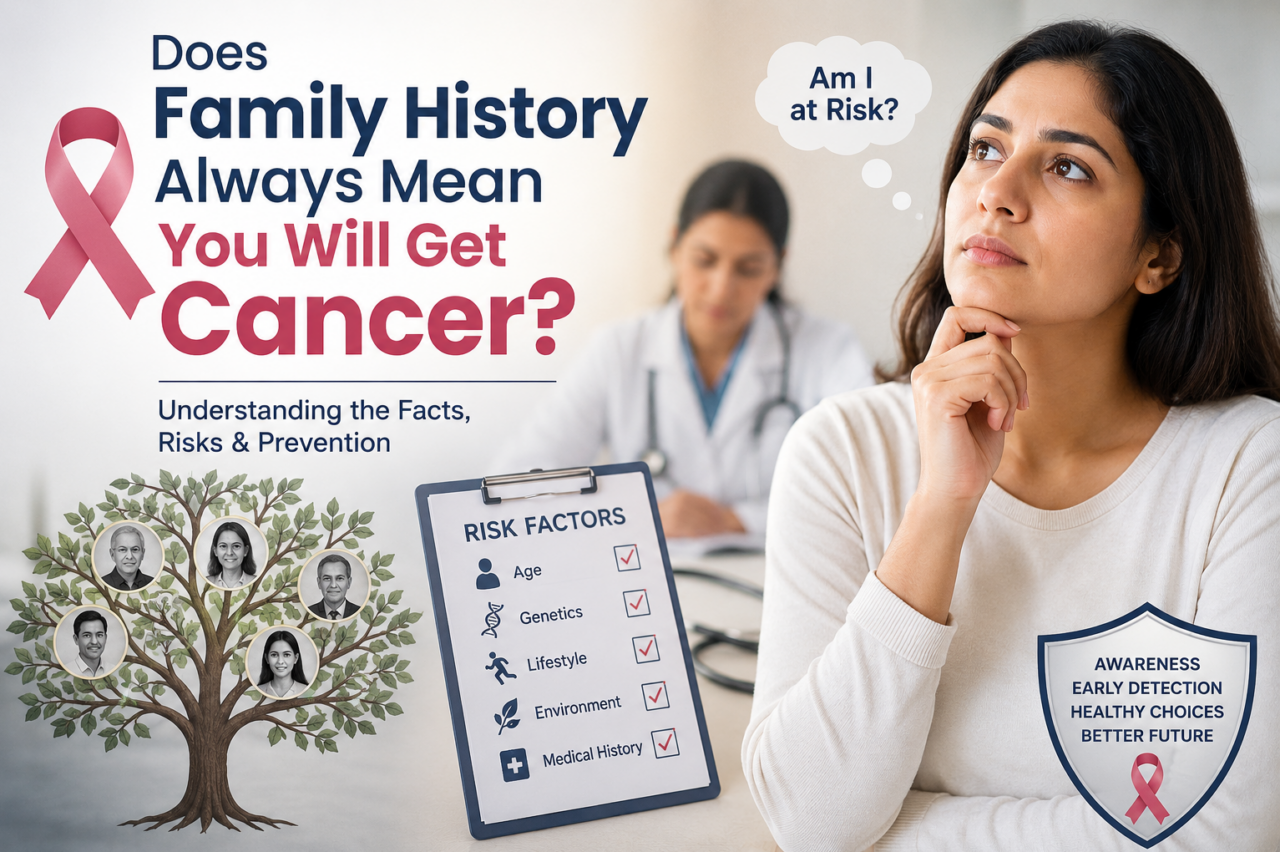
Does Family History Always Mean You Will Get Cancer?
The short answer is:
No.
A family history of cancer may increase your risk, but it does not guarantee that you will develop the disease.
Many people believe cancer is purely hereditary, but that is not how cancer works.
Even when someone inherits a gene mutation associated with cancer, additional genetic changes usually need to occur before cancer develops. This means that a person may carry a higher-risk gene and never develop cancer, while another person with no family history may still be diagnosed.
Cancer risk exists on a spectrum. Genetics is one piece of the puzzle, but it is not the entire puzzle.
Factors such as smoking, obesity, physical inactivity, alcohol consumption, chronic inflammation, environmental exposures, infections, and simple biological ageing all contribute to cancer risk.
This is why two siblings with the same family history can have completely different health outcomes.
Understanding How Cancer Develops
To understand why family history is only part of the story, it helps to understand how cancer develops.
Every cell in your body contains DNA. DNA acts like an instruction manual, telling cells when to grow, divide, repair themselves, and die.
Throughout life, cells continuously divide and reproduce. During this process, mistakes can occasionally occur in the DNA.
Most of these mistakes are harmless.
Sometimes, however, certain genetic changes affect the genes that control cell growth. When enough of these changes accumulate, cells can begin growing uncontrollably. This uncontrolled growth can eventually become cancer.
These genetic changes can occur because of:
- Natural ageing
- Tobacco exposure
- Air pollution
- UV radiation
- Viral infections
- Alcohol consumption
- Obesity
- Random cellular mistakes
This explains why cancer can occur even in people who have absolutely no family history of the disease.
Hereditary Cancer vs Sporadic Cancer: What’s the Difference?
One of the biggest misunderstandings about cancer is that all cancers are inherited.
In reality, there are two broad categories.
Hereditary Cancer
Hereditary cancers occur when a person inherits a gene mutation from a parent.
These inherited mutations are present from birth and exist in nearly every cell of the body.
Examples include mutations in:
- BRCA1
- BRCA2
- APC
- TP53
- MLH1
- MSH2
These mutations can significantly increase the risk of developing certain cancers.
However, inheriting a mutation does not mean cancer is guaranteed.
It simply means the risk is higher.
Sporadic Cancer
Most cancers are sporadic.
These cancers occur because genetic changes develop during a person’s lifetime rather than being inherited from a parent.
Sporadic cancers are often linked to:
- Ageing
- Lifestyle factors
- Environmental exposures
- Random DNA mutations
The majority of cancer diagnoses worldwide fall into this category.
This means that most people diagnosed with cancer do not inherit it from their parents.
Why Cancer Sometimes Appears to Run in Families
Many families notice that multiple relatives have been diagnosed with cancer and assume there must be a hereditary gene involved.
Sometimes that is true.
But often there are other explanations.
Families tend to share:
- Similar eating habits
- Similar lifestyles
- Similar environmental exposures
- Similar cultural practices
- Similar smoking patterns
- Similar exercise habits
For example, if multiple family members smoke for decades, several of them may develop smoking-related cancers.
Similarly, families living in the same environment may experience similar exposures to pollutants, dietary patterns, or lifestyle risks.
This can make cancer appear hereditary even when genetics are not the primary cause.
Which Types of Cancer Are More Commonly Linked to Inherited Gene Mutations?
Certain cancers are more likely than others to have a hereditary component.
These include:
Breast Cancer
Mutations in BRCA1 and BRCA2 genes can significantly increase breast cancer risk.
Ovarian Cancer
Many hereditary ovarian cancers are associated with BRCA gene mutations.
Colorectal Cancer
Conditions such as Lynch Syndrome and Familial Adenomatous Polyposis can increase colorectal cancer risk.
Prostate Cancer
Some inherited mutations are associated with a higher risk of prostate cancer.
Pancreatic Cancer
Certain inherited gene mutations may increase pancreatic cancer risk.
Endometrial Cancer
Inherited conditions such as Lynch Syndrome may increase risk.
It is important to remember that even for these cancers, many cases occur in people with no hereditary mutation.
Warning Signs That Your Family History May Increase Your Risk
Not every family history is equally concerning.
Doctors look for specific patterns that may indicate hereditary cancer risk.
You may benefit from professional evaluation if:
- Multiple close relatives have had cancer
- Several relatives were diagnosed before age 50
- The same cancer appears across multiple generations
- One relative has had multiple primary cancers
- A known gene mutation exists in the family
- Breast and ovarian cancer occur together in relatives
- Colon and uterine cancers occur together in relatives
The stronger the pattern, the more likely it becomes that inherited factors may be contributing.
This does not mean cancer is inevitable.
It simply means additional screening and monitoring may be beneficial.
Should You Consider Genetic Testing?
Genetic testing helps identify inherited mutations that may increase cancer risk.
The test is usually performed using:
- A blood sample
- A saliva sample
Genetic testing may be recommended if:
- There is a strong family history of cancer
- Multiple generations have been affected
- Relatives were diagnosed unusually young
- A known mutation exists in the family
Testing can provide valuable information about future cancer risk.
However, it is not appropriate for everyone.
Results should always be interpreted by qualified healthcare professionals who can explain what they mean and what actions, if any, should be taken.
How a Cancer Doctor in Ahmedabad Evaluates Family Cancer Risk
When meeting with a Cancer Doctor in Ahmedabad, one of the first steps is reviewing your family history in detail.
The doctor may ask:
- Which relatives had cancer?
- What type of cancer did they have?
- At what age were they diagnosed?
- Were multiple cancers diagnosed in the same person?
- Has anyone undergone genetic testing?
This information helps build a complete picture of your risk profile.
Based on this assessment, recommendations may include:
- Routine screening
- Earlier screening
- Genetic counselling
- Genetic testing
- Lifestyle modifications
The goal is not to predict the future with certainty but to identify opportunities for prevention and early detection.
Can You Reduce Your Risk Even If Cancer Runs in Your Family?
Absolutely.
While you cannot change your genes, you can influence many of the factors that contribute to cancer risk.
Practical steps include:
Avoid Tobacco
Smoking remains one of the most preventable causes of cancer.
Maintain a Healthy Weight
Obesity is linked to several cancer types.
Exercise Regularly
Physical activity supports overall health and may reduce cancer risk.
Eat a Balanced Diet
A diet rich in fruits, vegetables, whole grains, and lean proteins supports long-term health.
Limit Alcohol
Excessive alcohol consumption increases the risk of several cancers.
Protect Yourself From Excessive Sun Exposure
Reducing UV exposure lowers skin cancer risk.
Follow Recommended Screening Guidelines
Early detection often leads to better outcomes.
Even individuals with inherited risk factors can benefit significantly from healthy lifestyle choices.
Why Early Cancer Screening Matters
Cancer screening is one of the most powerful tools available for early detection.
Many cancers produce few or no symptoms during their earliest stages.
By the time symptoms appear, the disease may be more advanced.
Screening helps identify abnormalities before they become serious.
Depending on age, risk factors, and family history, screening recommendations may include:
- Mammography
- Colonoscopy
- Pap testing
- HPV testing
- PSA testing
- Low-dose CT scans for high-risk individuals
People with strong family histories are often advised to begin screening earlier than the general population.
This is one reason why discussing your risk with a Cancer Doctor in Ahmedabad can be valuable.
When Should You Speak With a Cancer Doctor in Ahmedabad?
You should consider seeking professional advice if:
- Multiple family members have had cancer
- Cancer occurred at unusually young ages
- You are concerned about inherited risk
- You are considering genetic testing
- You want guidance regarding screening
A consultation can help determine whether additional testing or monitoring is appropriate.
Most importantly, it can replace uncertainty with evidence-based guidance.
Key Takeaways
- Having a family history of cancer does not mean you will definitely get cancer.
- Most cancers are not directly inherited.
- Inherited gene mutations increase risk but do not guarantee disease.
- Lifestyle factors and environmental exposures play major roles.
- Genetic testing may help some families understand their risk.
- Early screening remains one of the best tools for detection.
- A Cancer Doctor in Ahmedabad can help evaluate your personal and family history to guide screening and prevention decisions.
Concerned About Your Family History of Cancer?
If you have a family history of cancer and would like professional guidance regarding cancer risk, screening, or prevention, consult Dr. Vikesh Shah, Cancer Immunotherapy Specialist in Ahmedabad. A personalized evaluation can help you better understand your risk factors and make informed decisions about your health. Book an Appointment Today
Frequently Asked Questions
If my mother or father had cancer, will I get cancer too?
No. A parent’s diagnosis may increase your risk, but it does not guarantee that you will develop cancer.
Can cancer skip a generation?
Yes. Some inherited mutations can be passed through generations even when not every person develops cancer.
What percentage of cancers are hereditary?
Only a minority of cancers are directly linked to inherited gene mutations. Most occur because of acquired genetic changes over time.
Should everyone undergo genetic testing?
No. Genetic testing is generally recommended only when personal or family history suggests inherited risk.
Can healthy habits help if cancer runs in my family?
Yes. Lifestyle choices can influence overall cancer risk even when inherited factors are present.
At what age should I start cancer screening if I have a family history?
The answer depends on your specific family history and risk profile. Your doctor can recommend an appropriate screening schedule.
Is breast cancer always hereditary?
No. Most breast cancer cases are not caused by inherited gene mutations.
Not necessarily. Cancer is common, particularly as people age. A single diagnosis in the family does not automatically suggest hereditary cancer risk.